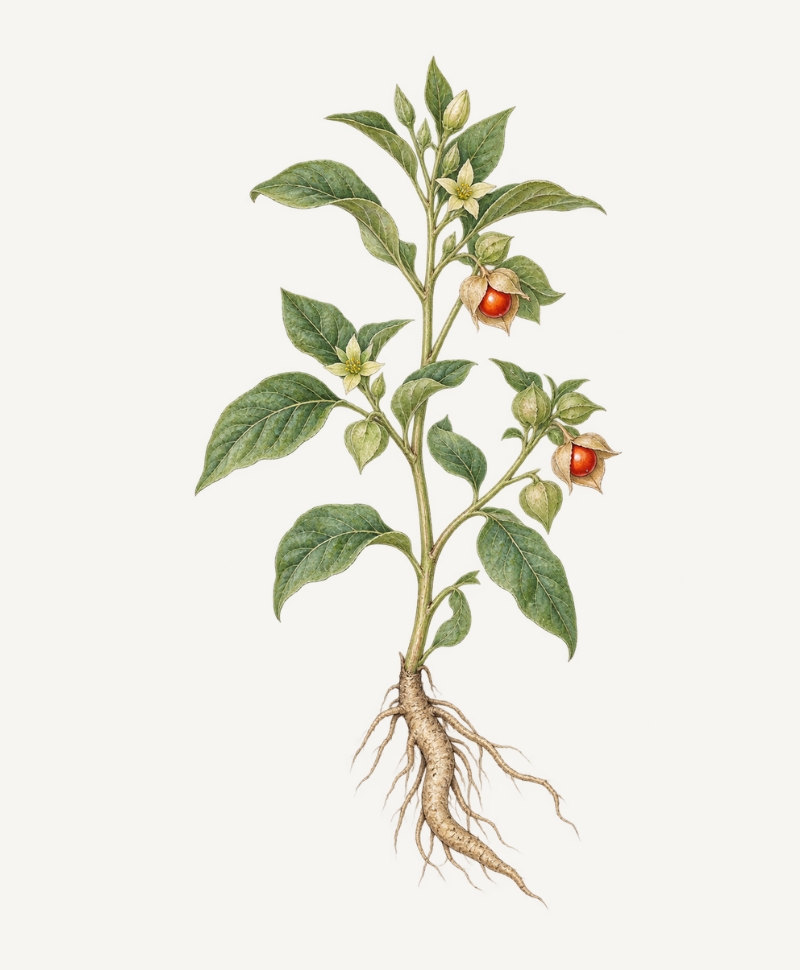
Ashwagandha
Withania somnifera
Solanaceae
India, Middle East & North Africa
Perennial Shrub
Grounding
Restorative
Ancient
The name ashwagandha comes from Sanskrit — ashva (horse) and gandha (smell) — a nod to the root’s pungent, horse-like aroma, and to the vitality it was traditionally said to bestow.
- A cornerstone of Ayurvedic medicine for over 3,000 years, where the root is classed as a rasayana — traditionally used to support vitality and longevity.
- Root powder traditionally stirred into warm milk or ghee as a tonic for strength and restful sleep — historical practice, not a clinical claim.
- Combined with honey or clarified butter in traditional formulations to support recovery after illness or physical exertion.
- Leaves applied topically in folk remedies for minor skin irritation — historical practice, not a clinical claim.
- Compact, downy-leaved shrub reaching 35–75cm, with small bell-shaped greenish-yellow flowers.
- Bears round orange-red berries wrapped in a papery, lantern-like husk — a family trait shared with its nightshade relatives.
- Thrives in dry, stony soil and semi-arid climates, tolerating drought better than most cultivated herbs.
- The root — pale, tapering, and fibrous — is the part most prized, typically harvested after 150–180 days of growth.
- Cultivated widely across India, particularly in Madhya Pradesh and Rajasthan, where it remains a significant agricultural crop.
The information provided on this page is for educational and informational purposes only and is not intended as medical advice. Always consult a qualified healthcare provider before using any herbal remedy, particularly if you are pregnant, nursing, taking medication, or managing a health condition.
Discover More Herbs in the Collection