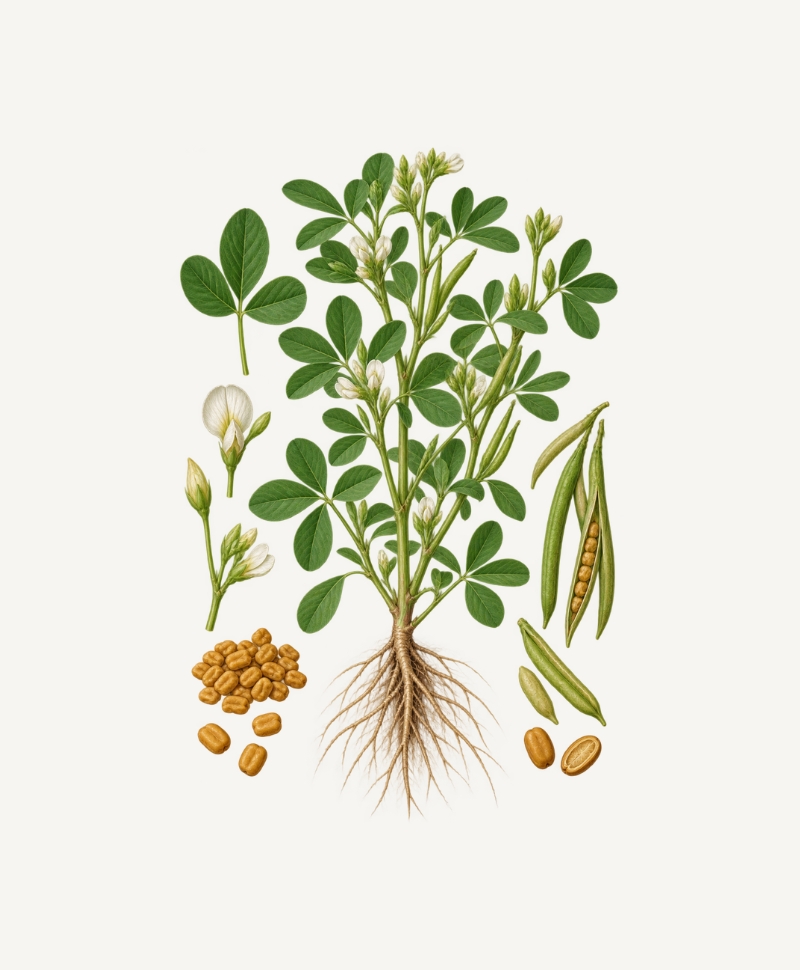
Fenugreek
Trigonella foenum-graecum
Fabaceae
India and Northern Africa
Annual
Fenugreek’s Latin name, foenum-graecum, means “Greek hay,” a nod to its ancient use as livestock fodder. The seeds owe their distinctive maple-syrup aroma to a compound called sotolon — the very same compound used to flavor imitation maple syrup today.
- Seeds and leaves (methi) are staples of Indian cooking, used whole or ground in curries, dals, pickles, and spice blends like panch phoran.
- Ancient Egyptians burned the seeds as incense and used them in embalming, while Ayurvedic tradition has long employed fenugreek to support digestion and ease inflammation.
- Folk herbalists have brewed the seeds into a tea to support digestion and nursing mothers’ milk supply — a historical practice, not a clinical claim.
- A fast-growing annual reaching about two feet tall, with a mild, clover-like scent throughout the plant.
- Leaves are trifoliate, made up of three small, clover-shaped leaflets.
- Small white to pale yellow flowers appear at the leaf joints in late spring.
- Flowers give way to long, slender, curved pods, each holding 10 to 20 hard, angular seeds with a distinctive furrow.
- Native to the Mediterranean, Western Asia, and India, and cultivated for thousands of years as both food and livestock fodder.
The information provided on this page is for educational and informational purposes only and is not intended as medical advice. Always consult a qualified healthcare provider before using any herbal remedy, particularly if you are pregnant, nursing, taking medication, or managing a health condition.
Discover More Herbs in the Collection