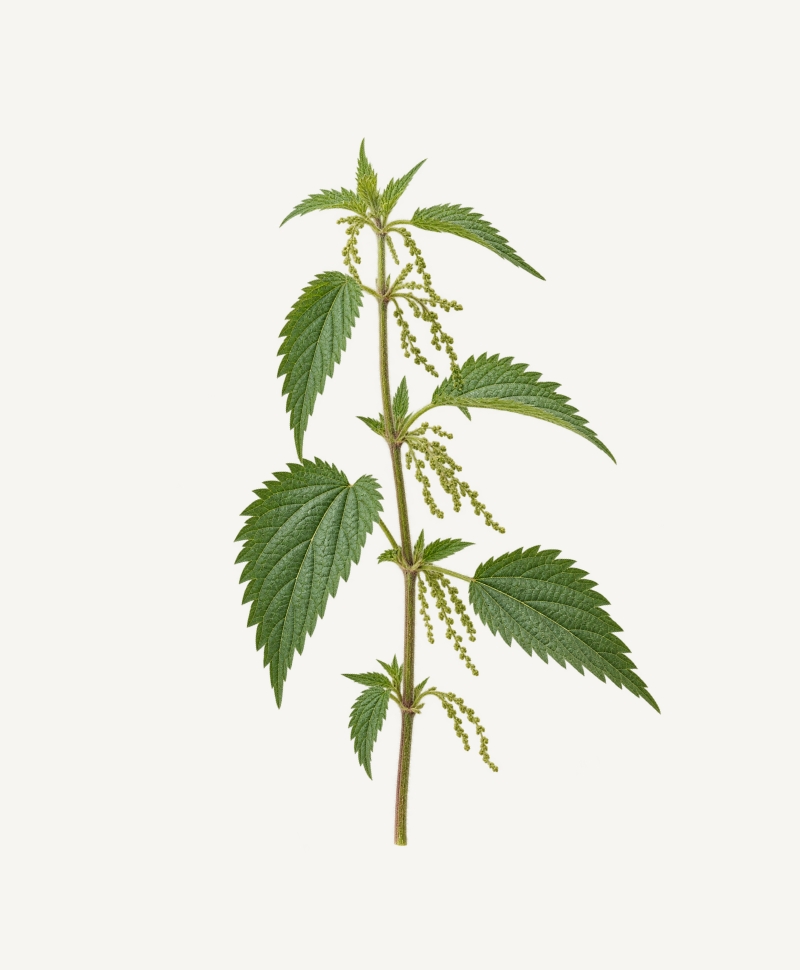
Urticaceae
Europe, Asia and North Africa
Perennial
Stinging
Fibrous
Nutrient-rich
The sting comes from tiny hollow hairs on the leaves and stems that inject histamine and formic acid on contact – a defence system perfected long before we started harvesting it. Cooking or drying disarms the sting completely, and the plant’s tough stem fibres were spun into cloth for centuries, valued alongside flax and hemp.
- Young spring shoots cooked and eaten like spinach across Europe – cooking neutralises the sting entirely.
- Stem fibres spun into cloth for centuries, prized alongside flax and hemp for their strength.
- Leaves dried and infused as a tea, traditionally taken as a spring tonic.
- Used in folk herbalism to support hair and scalp condition – historical record, not a clinical claim.
- Upright perennial reaching 1–1.5m, spreading readily by rhizome to form dense stands.
- Leaves and stems bristle with fine hollow hairs that deliver a sharp sting on contact.
- Toothed, heart-shaped leaves grow in opposite pairs up sturdy, square stems.
- Small greenish flowers hang in loose, catkin-like clusters from the leaf axils in summer.
- Favours nitrogen-rich soil, often marking the site of old settlements, middens or farmyards.
The information provided on this page is for educational and informational purposes only and is not intended as medical advice. Always consult a qualified healthcare provider before using any herbal remedy, particularly if you are pregnant, nursing, taking medication, or managing a health condition.
Discover More Herbs in the Collection